History taking
A real interview, spoken out loud.
Students lead the conversation in their own words: chief complaint, history of present illness, past history. The patient answers out loud, true to the case.
A product of Dewe AI
AI clinical simulation for medical students. Students see an AI-generated patient just as they would in a real visit: hold the button, speak, and the patient answers out loud.

Through the student’s eyes
Voice conversation, physical exam, tests, instant scoring, coach, and tutor. Everything the student sees, in just over a minute.
Step by step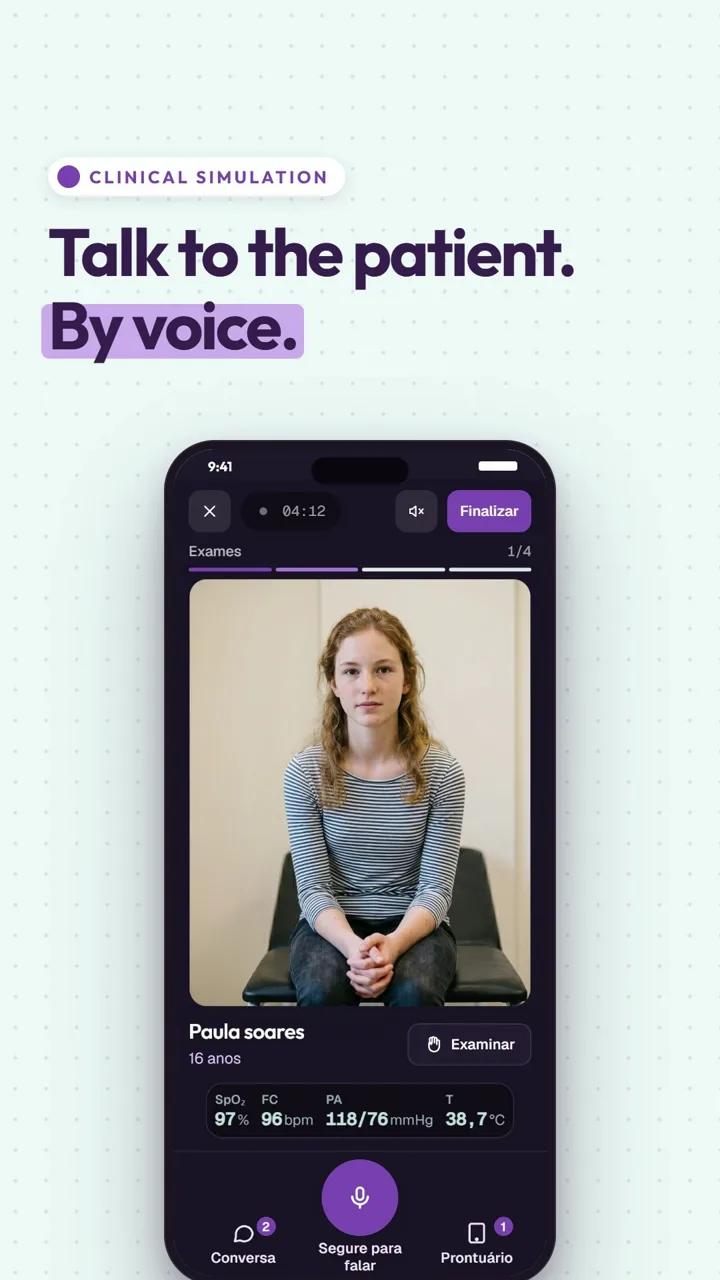
The encounter
The simulation follows the reasoning of a real visit, and each step is scored at the end.
History taking
Students lead the conversation in their own words: chief complaint, history of present illness, past history. The patient answers out loud, true to the case.
Workup
The physical exam uses instruments: thermometer, pulse oximeter, blood pressure cuff, auscultation, and palpation. Tests come back with results, straight into the chart.
Diagnosis
With the history, the exam, and the results in hand, students form a diagnostic hypothesis. Then they explain it to the patient, just as they would in clinic.
Management
Treatment, patient guidance, and next steps. When the student finishes, AI scores the whole encounter and opens the report.
Physical exam and labs
Every instrument returns a reading, and every test comes back with results. Students decide what to investigate, and in what order.
Illustrative values from a sample case.
AI assessment
When the student finishes, AI scores the encounter across all four steps, from 0 to 100. The score never comes alone:
Paula Soares · Gynecology
StrengthWas welcoming and listened to the patient’s worries.
What was missingIntroducing yourself to the patient at the start of the visit.
Instructor’s answer keyExpected: introduce yourself, answer her questions, and reassure the patient.
Tutor and coach
Optional. The tutor follows the encounter and corrects in real time. In this mode, the score is for practice and does not count toward the grade.
At the end, a voice coach talks with the student about the encounter: what went well, where they got stuck, and what to take into the next one.
Portuguese and English
Students choose the language before entering the exam room. In English, the patient speaks English, and the feedback and report arrive in English too. Clinical practice and language in one exercise, for schools that are internationalizing their curriculum.
For faculty
Cases, answer keys, and materials come from faculty. AI takes the repetitive work off their plate: it builds the case, gives the first score, and organizes class data. The final call is always theirs.
Case creation
Faculty describe the patient in their own words, the way they would to a colleague. AI asks for what is missing, such as vital signs, exam findings, and expected tests, and delivers a case ready for review, answer key included.
Assessments and exercises
Assessments are graded: they have a time window, an attempt limit, an optional timer, and a rule for which score counts. Exercises stay out of the grade, and students can redo them as often as they like. Notifications reach the class at the right time.
Class dashboard
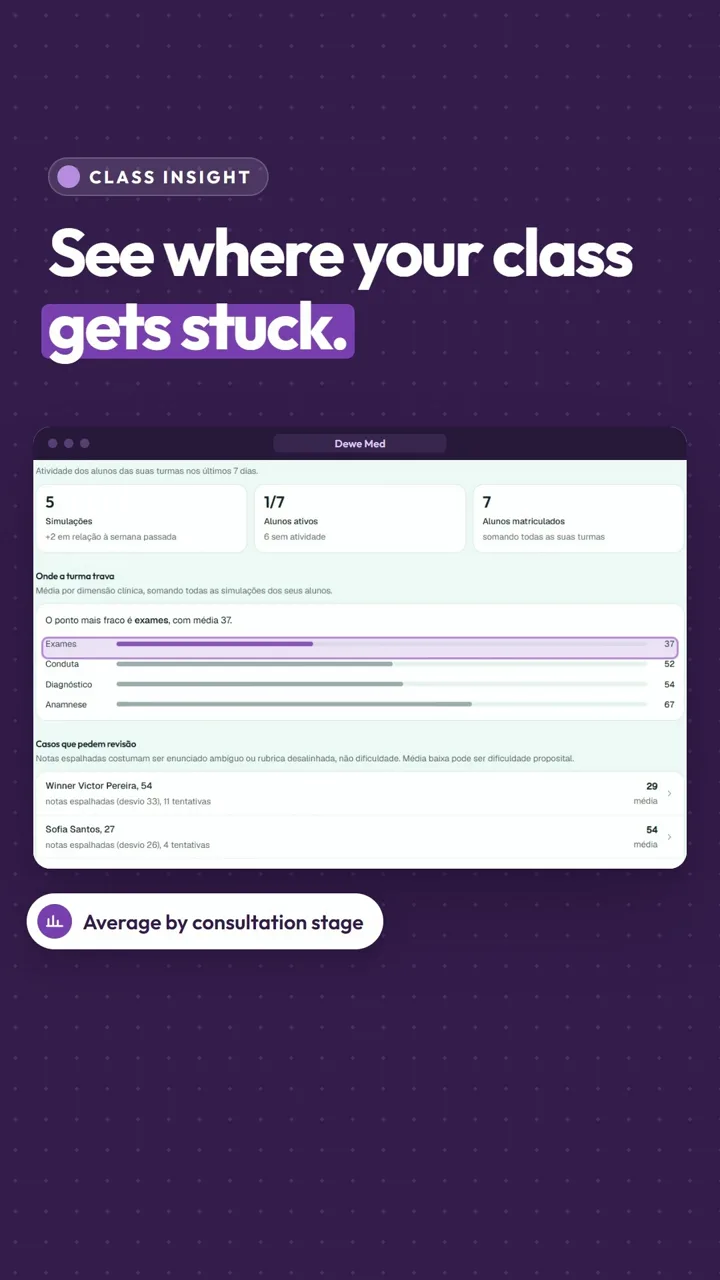
The class average shows up for every step of the encounter, and each student has a full report. If the class does well on history taking but drops on management, faculty know what to reinforce in the next session.
Materials and network
Cases, questions, and lectures live in one place and can be reused with other classes. A lecture becomes a PDF, flashcards, and a podcast for students to study. Questions published to the question bank can be copied by other faculty, so the institution’s knowledge keeps growing.
Scores with review
Faculty can adjust any step of the assessment. Every adjustment is logged with its rationale, and the original score is never lost.
We show you Dewe Med in action. Then, together with your program leadership, we design a pilot for your class.
Or write directly to contato@deweai.com